
[Table of contents]Show table of contents
The account manager said: “anything can be configured.” Technically he was right. Operationally — it was the most expensive lesson the client ever paid for. Configuring Salesforce to track vehicle production statuses is like using Excel as a database: it works until it hurts. And it always hurts at the worst possible moment.
Over 8 years we’ve built CRM/ERP for companies in automotive and FMCG. Every client had tried an off-the-shelf tool first. Every one bounced — not because Salesforce is bad, but because for them it was generic.
Automotive: a world where the VIN is king
A 2024 Cupra Born in Aurora Blue, production status known to the day, financing oscillating between leasing and long-term rental. That’s one specific record. A dealer runs 200 of them in parallel. An off-the-shelf CRM sees a “deal,” an amount, a pipeline stage. It doesn’t see that this Born is in transit from Zwickau, will arrive in 3 weeks, and the customer is waiting on a financing decision until tomorrow 14:00.
Premium dealers average 47 vehicle configurations per month. Each with its own VIN, factory status, financing path. These aren’t “leads” — they’re live objects that change state several times a day.
For Cupra Polska we built MyCarApp — a system that pulls factory, logistics, and dealer data into a single dashboard. The sales rep sees production status, delivery date, configuration history, and the financing portfolio. The customer gets notifications about their car. You don’t configure this in HubSpot, because HubSpot has no concept of what a VIN is.
What automotive needs from a CRM
VIN tracking at every stage: order, production, transport, pre-delivery inspection, handover. Integration with factory systems (AS400 or SAP). A financing calculator with auto-updated rates. Test-drive and demo fleet management. No off-the-shelf CRM ships this out of the box.
FMCG: pallets, couriers, and logistical chaos
Dried-fruit producer Terra Poland has different problems than a dealer, but the conclusion is the same: a generic CRM doesn’t understand their world. Terra doesn’t sell “units” — they sell pallets, cartons, and bags of varying weights. An order isn’t “100 pieces,” it’s “2 pallets of mango 500g, 1 pallet of mixed nuts 250g, delivery to ramp #3 on Wednesday 6:00-8:00.”
Integration with DPD, InPost, DHL. Waybills. Returnable pallets. Per-batch quality certificates. Salesforce will handle it after 6 months of customization and PLN 200k for a consultant. MoreSales for Terra went live in 8 weeks — because we modelled it on pain points we already knew from an earlier rollout: pallets, weight classes, couriers. The second build in the same industry costs half the first.
Anatomy of an off-the-shelf CRM failure
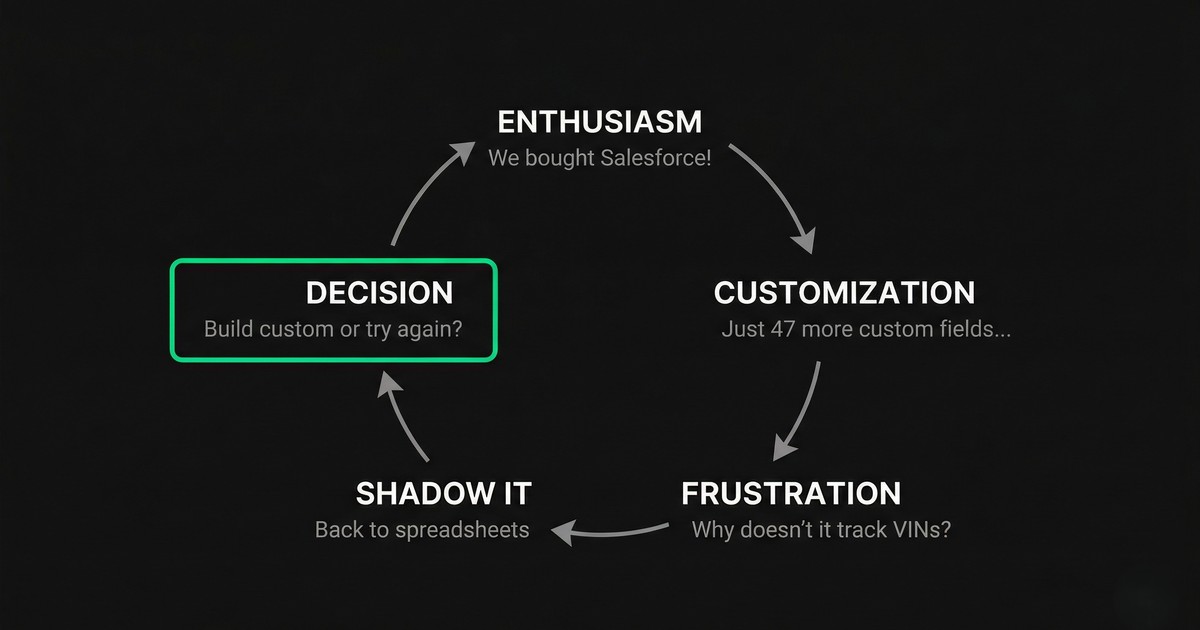
The pattern is always identical. Phase 1: enthusiasm. “Salesforce has everything.” Phase 2: customization. The consultant says: “this will take 6 months.” In month five the client asks: “can I just do this in Excel?” Phase 3: frustration. The system works, but it’s slow and needs a consultant on the clock. Phase 4: shadow IT. Users go back to spreadsheets. Phase 5: the decision — keep paying or start over.
Custom CRM vs. Salesforce: a decision framework
Standard core process? Buy off the shelf. Agency, law firm, consulting — HubSpot or Pipedrive will do. Industry-specific core? Build custom.
| Dimension | Off-the-shelf CRM | Custom CRM |
|---|---|---|
| Time-to-value | 2-4 wks + 3-6 mo custom objects | 8 wks - 6 mo |
| 3-year cost, 20 users | PLN 568-2,028k | PLN 330-940k |
| Cost model | Per-seat + consultant by the hour | One-time build + flat maintenance |
| Industry objects | Custom objects (separate licenses) | Native to the domain |
| Vendor lock-in / Shadow IT | High | Low |
The five-field test: three of the five key data points a sales rep needs don’t exist as native fields in off-the-shelf CRM — custom wins. Automotive: VIN, production status, configuration. FMCG: pallets, weight classes, certificates. Standard B2B: amount, stage, date — here Salesforce wins.
TCO: numbers instead of promises
For a 10-person dealership: €120-240/user/month on Salesforce = €14,400-28,800/year in licenses. Custom CRM PLN 150k one-time — break-even in 5-9 months.
A 20-person team, 3 years: off-the-shelf CRM PLN 360-1,440k licenses + PLN 100-300k customization + PLN 108-288k consultant = PLN 568-2,028k TCO. Custom CRM: PLN 150-400k one-time + PLN 180-540k maintenance = PLN 330-940k TCO.
Two items missing from those numbers: the cost of reshaping your process to fit the CRM’s limits (hundreds of team hours per quarter), and shadow IT (spreadsheets running alongside the system). In specialized industries those two outweigh everything else combined.
Takeaways
Your industry has a problem Salesforce can’t see. For Salesforce it’s a feature to upsell. For you it’s the core your company stands on. That asymmetry breaks every rollout.
Don’t build custom CRM to spite Salesforce. Build because your industry operates on objects generic tools can’t cover without pain. Automotive, FMCG, real estate, medtech have their own pallets, VINs, certificates. Better to invest in custom software matched to the process than to bend the process around someone else’s data schema. The second path ends in compromises more expensive than a custom build.
Got an off-the-shelf CRM that can’t keep up with your industry? Describe your project in the configurator or write to office@domoresoft.com with the subject “CRM rescue assessment.” 30 minutes of conversation, the five-field test on your team, no strings attached.
FAQ
When to build a custom CRM instead of Salesforce? When the core process is industry-specific. Three of the five key sales-rep fields don’t exist in off-the-shelf CRM as native — custom wins.
3-year TCO of custom CRM vs Salesforce? For 20 people: custom PLN 330-940k, Salesforce with customization PLN 568-2,028k. Custom break-even in month 18-24.
Why do automotive and FMCG need custom CRM? They operate on objects Salesforce doesn’t know: VIN and production status (automotive), pallets and per-batch certificates (FMCG).
How long does a custom CRM implementation take? From 8 weeks (MoreSales for Terra) to 6 months (MyCarApp with Cupra factory integrations).