
[Table of contents]Show table of contents
When Grzegorz, CEO of Terra Poland, first called us, he said one sentence we won’t forget: “We have 47 Google Sheets and every one of them shows a different version of the truth. 47 sheets because sales tracked orders, the warehouse tracked stock, accounting tracked invoices. Nobody was syncing anything. When an order came in, three people had to agree whether we could ship it. That took hours.” Terra is a Polish producer of dried fruit, nuts and trail mixes, supplying over 200 retail points across Poland and Germany. The company was growing 40% year-on-year. Operations weren’t.
Problem: five days of latency in a single order
Monday: order arrives by email. The sales rep types it into their sheet. Wednesday: the warehouse checks against its own. In stock? Fine. Friday: invoice goes out, accounting flags it. For five days nobody actually knew what was happening.
Orders came in by email, phone and WhatsApp. Sales reps entered them into spreadsheets — each one their own. The warehouse kept a separate sheet for stock. Accounting kept another for invoices. Nobody knew in real time how much product was available, ordered, or in production.
The result: 5 order errors a day on average. Duplicate shipments, missing items, wrong addresses. The team burned 30 hours a week verifying and correcting data. Grzegorz estimated each error cost the company around PLN 350 — in returns, excess stock, and lost customer trust.
Diagnosis: why people keep their own spreadsheets
The temptation: build a master spreadsheet. I said no. First we needed to understand why people keep separate sheets at all. The answer: trust. Each person had their own version of the truth because they didn’t trust anyone else’s.
Before writing a single line of code, we spent three days on-site at Terra. We talked to sales reps, warehouse staff, accounting. We mapped every process and every point where data was transferred by hand from one system to another.
Magda from sales: “I have to call the warehouse every morning.” That one sentence shaped the architecture. The system had to eliminate the morning phone call — not make it smoother, make it unnecessary.
We identified 7 points where data diverged. The worst — manually transcribing orders from emails into spreadsheets — produced 60% of all errors. The second — no sync between stock levels and orders — accounted for the rest.
Migrating from spreadsheets to a system — steps and timeline
We could have built a portal. Instead we made order entry so simple that the old spreadsheet rhythm died on its own. No fight over trust — one source of truth.
Terra is a 35-person company. It didn’t need SAP or Salesforce — it needed a tool sized to its scale. We deployed MoreSales, our CRM/ERP built for production and distribution SMBs.
Order module
Orders enter through a web form, email integration, or direct EDI import. Each one immediately reserves stock, generates a dispatch document, and enters the production queue. The sales rep sees status in real time, without calling the warehouse.
Warehouse module
Stock updates automatically on every event: receipt, dispatch, return, production. The system fires alerts when stock drops below the safety threshold. No more surprises like “we’re out of mango and the client is waiting.”
Management dashboard
Grzegorz got a dashboard he never had before: real-time sales, margin per product, profitability per client, forecasts based on order history. One place, not 47 sheets.
Rollout: 8 weeks, not 8 months
Weeks 1-2: system configuration and historical data migration. Weeks 3-4: team training and parallel operation (old and new system running side by side). Weeks 5-6: full cutover with on-site support. Weeks 7-8: tuning, automations, and custom reporting.
Architectural call: we didn’t kill the spreadsheets on day one. For two weeks both systems ran in parallel. That gave the team time to build trust in the new tool. By week three they asked us to switch the sheets off themselves, because the new system was faster and more reliable.
Results after 6 months
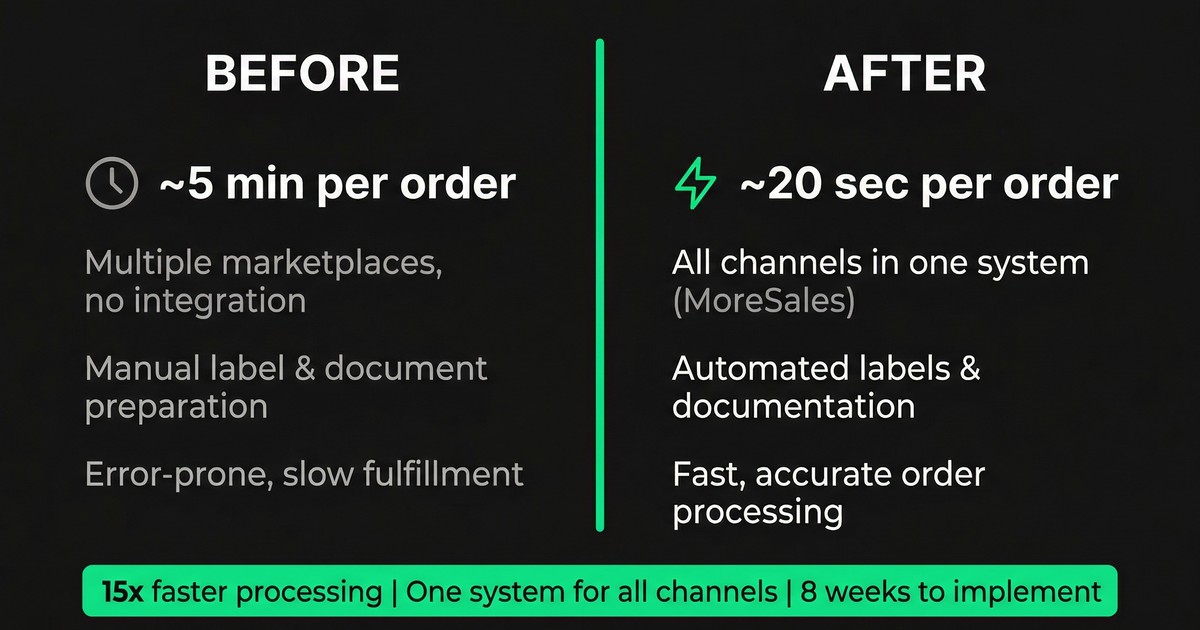
30 hours of verification down to under 1. That’s one admin salary reclaimed per month. Over 3 years, PLN 150k. 95% drop in errors (from 5 a day to 1-2 a week). Order fulfillment 40% faster.
Grzegorz stopped coming into the office on Saturdays. That was the tell. When the CEO isn’t putting out weekend fires, you know the system is working. Sales reps started selling instead of correcting orders. Warehouse staff started optimizing shelf layouts instead of hunting for missing pallets.
Lessons for other companies
Terra isn’t an outlier. We see the same pattern across dozens of production firms: growth outpaces process, spreadsheets turn into Frankenstein, the team spends more time on admin than on work that generates value. Process automation doesn’t have to be expensive or complicated. It has to fit the company’s scale and shape.
FAQ
How do you migrate from spreadsheets to a business system? Start with operational interviews (2-3 days on-site), then map processes and data divergence points. Migrate historical data in batch mode, run two weeks of parallel operation (old + new together), and only switch the sheets off when the team asks you to. The key: never kill the old system before trust in the new one is built.
What are the costs and returns of ERP for an SMB? For a 35-person company like Terra: MoreSales rollout 80-150k PLN one-time + 2-5k PLN/month for upkeep. The return: 30 hours a week reclaimed equals one admin salary, about PLN 50k a year. Plus error reduction (PLN 350 × ~1,000 errors/year = PLN 350k). ROI under 12 months.
How long does a CRM/ERP rollout take for an SMB? For a company up to 50 people: 6-10 weeks with MoreSales (a system built for production SMBs). SAP / Salesforce: 6-12 months plus consultants. The difference isn’t technology — it’s fit-to-scale. Corporate ERP demands process configuration that an SMB doesn’t have and shouldn’t have.
How much time can process automation actually save? Terra: 30h/week in a 35-person company. The pattern repeats across FMCG and distribution: 5-15% of admin work reclaimed in the first year. The absolute gain scales with company size, but the percentage stays surprisingly stable.